
Introduction

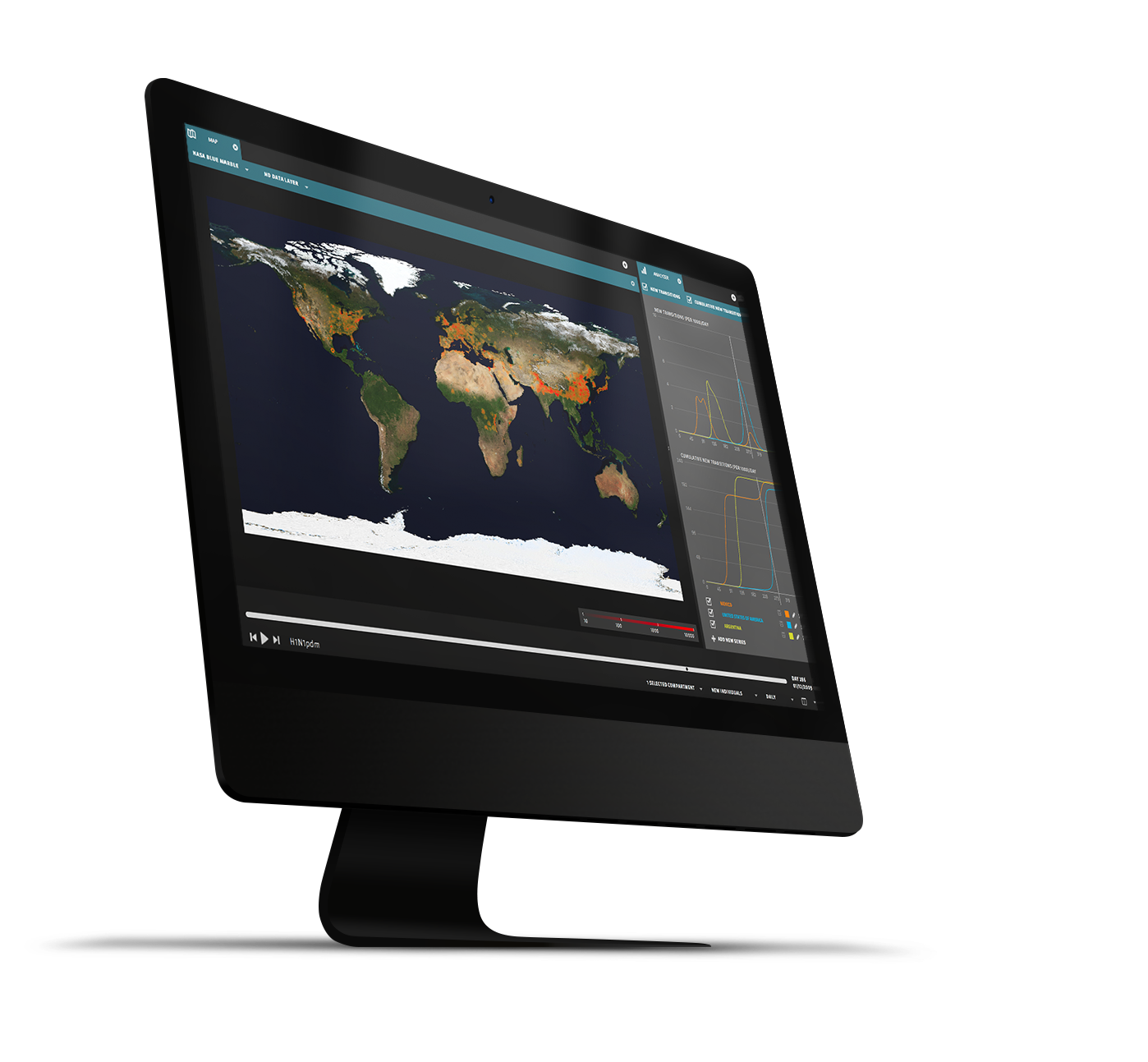
GLEaM is a Global Epidemic and Mobility modeler that integrates sociodemographic and population mobility data in a spatially structured stochastic disease approach to simulate the spread of epidemics at the worldwide scale. Read more about GLEaM.

The GLEaMviz project covers the research conducted with GLEaM as well as the tools derived from it. This website reports on the progress of this project, its main results, publications of academic papers and editorial material, presentations at international conferences and workshops, and other outreach activities.

Please subscribe to our RSS or Atom feed or follow gleamviz on Twitter to stay up-to-date.

Feature in Physics World magazine

February 28th, 2010

The February 2010 issue of Physics World presents a special focus on Complexity and challenges in Network Science. From mapping the rise of the field, to examples of applications rooted in our everyday life, to charting the field’s possible future evolution, the special issue explores the key topics of Network Science - a field where physicists have been playing a major role.

Physics World, February 2010 issue.

Physics World, February 2010 issue.

The Flu Fighters.

The Flu Fighters.

A special feature is dedicated to infectious diseases, how they rapidly spread in our modern society, and what weapons we have nowadays to fight them.  The article titled The Flu Fighters by Vittoria Colizza and Alessandro Vespignani describes the contribution of physicists to an interdisciplinary area where complex systems are the main ingredients, and modeling human behavior and biological contagion is the ultimate challenge. The cover of the special issue shows an illustration by B. Goncalves et al. of the multiscale worldwide mobility networks used in the GLEaM model.

New publication on the Proceedings of the National Academy of Sciences: GLEaM sheds light on the impact of multiscale mobility networks on spatial epidemic spread.

December 23rd, 2009
PNAS cover image.

PNAS cover image.

In the issue of December the 22nd of the Proceedings of the National Academy of Sciences, we publish a paper that discusses the interplay of human mobility patterns like those between local metropolitan commuters and long-range airline travelers during a global epidemic. The image of the worldwide mobility network constructed in our paper has been featured in the cover of the journal.

Multiscale mobility networks and the spatial spreading of infectious diseases.
D.Balcan, V. Colizza, B. Gonçalves, H. Hu, J. J. Ramasco, A. Vespignani
Proc Natl Acad Sci U S A 106, 21484-21489 (2009).

In the paper we detail the definition of the worldwide multiscale mobility network at the core of the Global Epidemic and Mobility (GLEaM) model and discuss the data integration process and the statistical analysis that allow its construction.

Have a look at this video presenting an overview of the GLEaM model.

We also tackle some general theoretical questions that concerns the basic understanding of the spatial spread of infectious diseases on the large scale:
i)    Is there a most relevant mobility scale in the definition of the global epidemic pattern?
ii)    At which level of resolution of the epidemic behavior a given mobility scale starts to be relevant and to which extent?

In order to fully consider the effect of multiscale mobility processes we first integrate data of commuting patterns in five different continents with the airline transportation database and then develop a time-scale separation technique for evaluating the force of infection due to different mobility couplings and simulate global pandemics with tunable reproductive ratios. The results obtained from the full multiscale mobility network are compared to the simulations in which only the large scale coupling of the airline transportation network is included. Our analysis shows that while commuting flows are, on average, one order of magnitude larger than the long-range airline traffic, the global spatio-temporal patterns of disease spreading are mainly determined by the airline network. Short-range commuting interactions have on the other hand a role in defining a larger degree of synchronization of nearby subpopulations and specific regions which can be considered weakly connected by the airline transportation system.

It also is possible to show that short-range mobility has an impact in the definition of the subpopulation infection hierarchy. In other words, global disease outbreaks tend to touch down at major travel hubs, generally major airport locations and spread out like a wave that follow local commuting patterns. The findings of the paper open the path to quantitative approximation schemes that calibrate the level of data resolution and the needed computational resources with respect to the accuracy in the description of the epidemics.

The techniques developed here allow for an understanding of the level of data integration required to obtain reliable results in large scale modeling of infectious diseases and have already have contributed to the improvement of the computational model we use to provide estimates and projections of the H1N1 pandemic.

Previous posts